
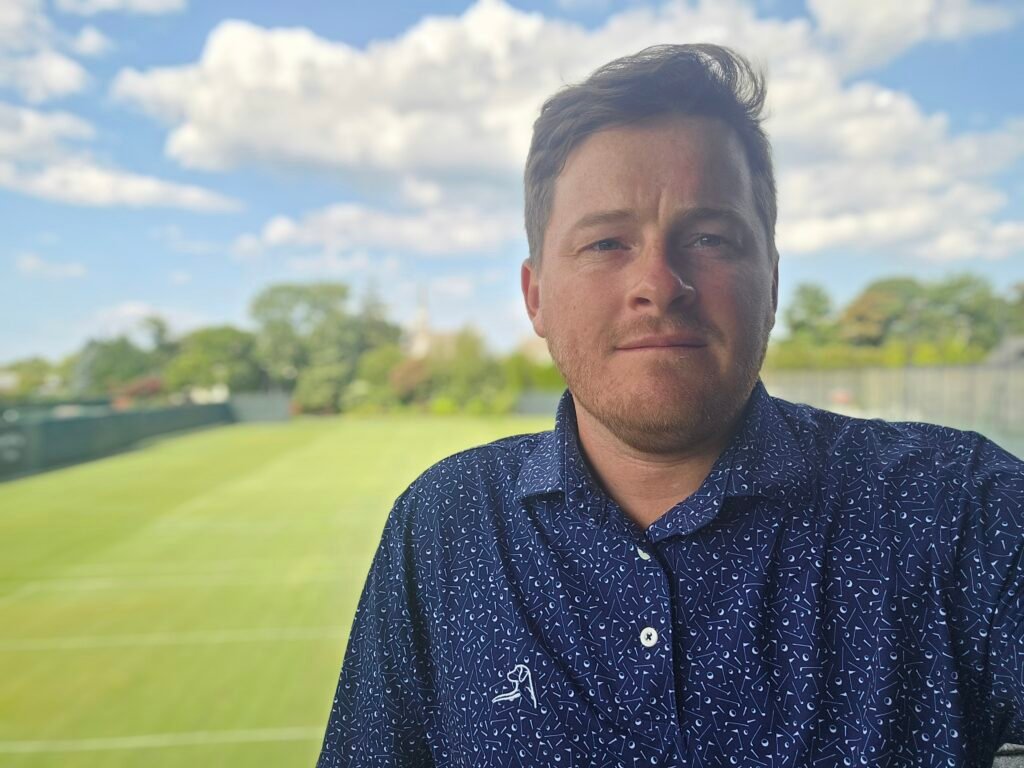
In this Meet The Members interview, we’re chatting to Kyle Cwynar, Superintendent at Seabright Lawn Tennis & Cricket Club in the New York metropolitan area. Kyle has been in the industry for over 20 years, and has a background in golf, but now works in the sports turf sector. Here, Kyle shares his experience working and living across the US, as well as his opportunity to work in Australia, and his recent establishment of The Grounds Committee.
Q: Take us back to 2004. How did a young Kyle Cwynar end up working in turf at Hyannisport Club?
Well, I’m from Cape Cod, which is a coastal community in Massachusetts, where if you’re a local, you’re either a landscaper or a lifeguard. I was riding a bike, caddying, decided it wasn’t for me, and I was always looking at the grounds team and being interested in what they were up to. I got a job in a local spot, had some great role models early, and my career kicked off from there.
Q: What was it about those early experiences that made you think, “I could actually make a career out of this”?
Early on, I didn’t think I’d make a career out of it. I’d initially gone to college abroad in Ireland on a business degree. It took a few semesters to realise it wasn’t for me. The golf course felt more natural and right for me. I had a spot lined up for me, and my old bosses advised me on agricultural schools and programmes. I understood that there was a pathway and that it was doable. I could put a career in turf towards a successful life; not having to be in an office in front of a computer seems alluring, and also knowing how much you can travel with it. It seemed like a good way you could go through life.
Q: You’ve now got more than 20 years in the turf industry. When you look back, what are some of your favourable moments in terms of the clubs you’ve worked at?
I’ve been lucky to have a bunch. I’ve front-roaded the higher-profile spots. I went from a nice private spot in Cape Cod to number one in the state in Boston with Brookline. From there, I thought, why not keep going with number one in the country, Pine Valley? Then, I went across to New South Wales. You feel that there’s something special with those places, whether it’s a big event or if it’s just you out there with the wildlife and the sky. People will pay crazy amounts to be at these places while we’re getting paid to enjoy them.
Q: How did you find the transition from golf to tennis and the cricket side of turf maintenance?
Going from golf to sports is definitely a transition, bringing a lot of the same tactics, using the same tools, but with a different set of goals. There’s nowhere to hide in sports turf. On a golf course, if the third tee has a dinged-up corner, people forget by the time they’ve finished the course. But if a tennis court has something going on, people are looking at it for a few hours. There are different problems.
Q: Have there been any major tournaments that have stood out for you?
What’s been interesting for me is not the televised events. I’ve had the ability to be around some real authentic amateur events that were a standout in my career. I volunteered with the Cape Cod Baseball League; it’s a bunch of future professionals playing, and people from town bring a lawn chair to sit and watch. They can grab an autograph from the guys after the game. You get a different take on a sport; it’s a bit more authentic, and it’s pretty much in a park. Going into golf, at Pine Valley, it was the Crump Cup. It’s another amateur event. There are no grandstands or TV cameras, but on the final Sunday, they invite the public to walk around. It’s all happening authentically in front of you. Coming to Tennis now, there’s this collegiate event that we’re hosting. It’s another authentic thing. It’s not on TV, but it’s high-level tennis. It’s a pretty neat way to watch a game.
Q: One thing that seems to run through your career is putting yourself in uncomfortable situations to learn. Where did that mentality come from?
I think it’s discipline to the end goal. Once you make small decisions that align with your end goal, they tend to snowball. Exposing yourself to opportunities speeds things up. Travel can be beneficial. You might sit next to somebody on a flight or meet people at a hostel. It’s being open to experiences and meeting those experiences with an attitude to make the most of it.
Q: What’s your end goal?
I’ve been lucky enough to do a lot, but it’s becoming time to turn around and hold the door open for kids coming into it. I think exposing more kids to this as a career path and inspiring them to make the most of their early years and travel themselves has become a passion over the past few years.
Q: You then went from the US to New South Wales Golf Club in Sydney. Why Australia?
It’s just somewhere I’ve always wanted to be. Thinking of travelling initially, my mum took me on a European trip, and we visited Quebec in Canada. I always wanted to travel. English-speaking, happy people, everyone’s nice, made for an easier transition than being dropped in somewhere completely foreign. At the time I was wrapping up my second year at Pine Valley, and there wasn’t really a spot open for me on the management team, so I decided to keep my momentum going and made some shots in Australia. I spoke to Gary (at New South Wales Golf Club), who said that if I could get myself over there, I had a job. At the time, they were doing a renovation project of all 18 greens, so he said, “You’re going to be coming in right in the thick of that.” I jumped at that opportunity, found a place to live, and got going.
Q: What was the biggest culture shock moving to Sydney — both professionally and personally?
I think the pace was a bit different. Going from a place like Pine Valley where detail is scrutinised and you’re putting in that kind of effort to make it what it is. Not that it wasn’t important in Australia, but it was a friendlier atmosphere, everyone is more down to earth. It was just a fun time. I don’t know if it was lucking out with the right people at the time, or if that’s just what all of Australia is like.
Q: You were involved with renovations, bunkering, greens work and warm-season turf. What did Australia teach you that you simply couldn’t have learned by staying in the US?
I think getting there for the project wrapping up, getting the experience, especially as a young guy, working with the superintendent on raking bunkers, doing a project of that scale in one of the top-ranking courses, but with the emphasis of “enjoy your weekend”. I did a lot of travel outside of work, but then on Monday, I’d get back in the saddle. Going from cool-season to warm-season grasses was different for me, too.
Q: Your career hasn’t been completely linear, and you’ve openly talked about jobs that didn’t work out and times when you questioned your decisions. Have you ever taken a job that you knew wasn’t right for you but learned something valuable from it?
I think everyone has experience of when you don’t necessarily vibe with the manager, or you outgrow the role that you’re in. You’re not handcuffed to any one place, and if your supervisors have your best interests in mind, they want to see you progress as well. Coming back from Australia, it wasn’t hiring time in America, the way the seasons lined up. I was working for some friends, then I ended up working for some other friends. It wasn’t the right fit, and I bounced around for a bit. Then, I was lucky enough to land a spot in New Jersey on the coast with a great mentor. I was doing everything on the course, handling emergencies, coordinating with the contractors. It was a negative turned positive. When one door closes, another opens, and you just keep going through.
Q: How important is it for people to understand that career progression isn’t always upward and straightforward?
I think it’s hugely important to know that the industry exists beyond the gates of your facility. Not every place runs the way yours does. When it was time to go for an internship, I thought, “I’ll just use the plan at the place I work at”, but the guys advised me to go somewhere new. Maybe the environment is different, or someone does something different, or the people are different. You’ve got to be your own advocate but understand just how many opportunities there are out there. You can go across your town and there’s something completely different going on. If you’re in golf, there’s sports turf. If you’re in sports turf, there’s golf.
Q: Do you think social media gives young greenkeepers an unrealistic impression of the industry?
I think overall, social media is a positive, because more people understand that it’s a job that you can get. But not all clubs have the resources and the people that the biggest courses have. It’s great to know what can be done and see what’s available and doable at that level, then try your best to emulate it at the smaller local clubs. What I try to share is a bit more realistic. You’re going to miss birthday parties and nights out. There’s a real side to it.
Q: If you could go back 20 years and give yourself some information from today, what would that be, and how impactful do you think it’d be on your career?
I think it would be to keep on travelling. That was such a fun time of my life, and there were more places I could have gone to. Not that I have any regrets now, but I see the guys who are travelling, and it makes me see how many opportunities there are. It’s all still out there, though.
Q: You eventually moved into Seabright Lawn Tennis & Cricket Club, rather than continuing purely down the golf route. How did you find being thrown into a sports club with a lot of different things going on?
I was just keeping myself to the same standard. My position before this was only three miles down the road, so it wasn’t a huge change in terms of locality. Coming here was more a boost of energy than a challenge. This was a place with history and tradition that was open to new ideas and practices.
Over the course of the week, we have maintenance Mondays for the courts; Tuesdays and Thursdays are fully open, so that’s just morning prep. Wednesday we have a bit of a maintenance window until the afternoon, and then the weekend is full-on play. It’s a coastal area, but it’s not truly seasonal. In winter, they switch to platform tennis, which is just as alive in the club, but it’s definitely a bit of a shift from the summer. It’s a bit more casual but still just as competitive and busy.
Q: Moving on to the present day, you’ve now created The Grounds Committee. What is it, and what was the problem you saw in the industry that made you think, “Someone needs to do something about this”?
It’s a resource for anyone trying to get into the industry and get an understanding of what goes on, with access to people in the field doing it. We have sports turf managers, golf managers, horticulturalists, people managing cemeteries. It’s different people getting together who all manage grounds. We’ve put together an introductory course that’s a webinar you can work through, allowing you to make your workplace your classroom.
When I look back on my time, if you don’t work in a place with a mentor, you have to rely on yourself to keep your career going. If you can take on one new thing a month, it accumulates. You can put together building blocks instead of stepping stones. It’s all about getting traction, getting a realistic outlook of what’s going on. There are a lot of people who want to share what they do, and it only takes one kid reaching out. If you’re making an effort to better yourself, that’s what we’re here to help.
Q: Having worked in both golf and wider sports, do you have a preference?
I do like sports. I don’t know if it was because I was in golf for so long that the novelty of sports hasn’t worn off yet, but I do appreciate team sports.
Q: Are there any job roles that you’d still like to take on?
I like the idea of working in a small, sleepy mountain town with some elevation. I think doing it for the town and having the regular people showing up, that’s the lifestyle I can see myself living long-term. Being around the New York City environment recently, there’s a lot of pressure, and it’s very busy, bustling. There’s a different allure there to this reality on the coast.
Q: What’s one piece of equipment that you couldn’t live without?
Going from golf to sports turf, I think it’s been the same in both, and it’s probably the ProCore. That seems to have the biggest impact on the turf as well as the mental aspect. I always feel better after a solid tine goes out. If you time it right, you have a couple of days where you can back off for a second. It’s the best tool to get out there and make a big difference.
Q: You’ve gone from a young greenkeeper on Cape Cod, through some of the most prestigious turf facilities in the US, across the world to Australia, into sports turf, and now into career mentoring and development. If you could pass on some advice to someone just starting out in the industry, what would it be?
Don’t go away. If there’s something you want to try and you have concrete goals, not every place is going to work with what you’re trying to do or value what you’re bringing, but you can learn just as much about what not to do as what to do. Identify early role models whose lives you could see yourself living, and learn from them what to do, what makes them successful. Make small decisions and have a goal in mind. Be open to new experiences, and if you know inside yourself that you’re moving towards it all the time, whether you’re at a place that’s making it smoother or harder, just keep going.
Big thanks to Kyle Cwynar for taking the time to share his expertise in this Meet the Members interview. You can contact him via thegroundscommittee@gmail.com or by visiting The Grounds Committee’s Instagram profile. Or, visit The Grounds Committee website here.