
Sponsored article on behalf of Regen Amenity. Written by Lee Carter of AgStone LLC, which supplies Regen Green+ Liquid Seaweed Extract. With input by Franck Henequart, Managing Director of ALGAIA and founder of the low temperature extraction process for Laminaria seaweed.
For decades, seaweed has been a trusted component of sports turf management. Whether preparing surfaces for tournament play, helping recovery after renovation, or building resilience during periods of drought and environmental stress, seaweed extracts have earned a permanent place in many agronomic programmes.
Ascophyllum nodosum, harvested from the cold waters of the North Atlantic, has been in the global biostimulant market for several decades now. It is the most researched brown seaweed species and has consistently demonstrated improvements in plant health, stress tolerance, rooting and nutrient efficiency.
Over many years, it was the easiest to access and collect, armed only with boots and a knife over the rocks. This is why it has been the first one to be used and most studied leading to all those agronomical studies.
However, several other brown seaweed species are also used even if under studied with their own specific benefits.
I talk to a lot of customers all over the world about seaweed and I think I can say it people’s perception on Seaweed – Kelp can differ. This is a narrative very much controlled by the distributors they deal with and the product line they have.
I hope to explain a few things and questions you should be asking your representative.
“The less you change nature, the more nature can work for the plant.”
What we need to know to navigate the minefield of seaweed suppliers:
What Is Your Seaweed Source?
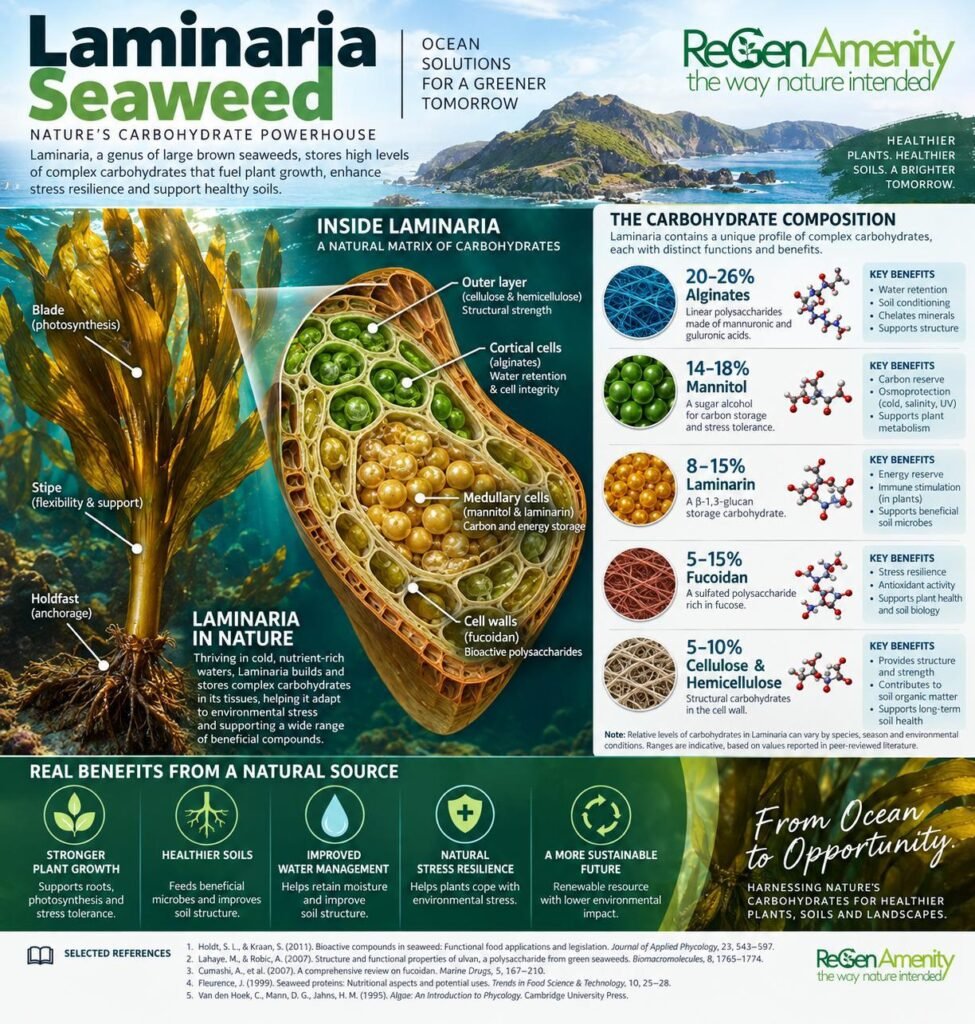
Brown seaweeds are the most used and Ascophyllum remains the most researched species, Laminaria has attracted increasing interest because of its naturally high concentration of key compounds associated with stress tolerance.
Laminaria contains significant higher levels of:
· Carbohydrates | · Benefits |
· Mannitol | · Mannitol acts as an osmoprotectant and helps the plant manage water in times of osmotic stress |
· Alginic Acid | · Improves moisture retention around the rootzone by binding to cations in place (Ca, Mg, Fe…) |
· Laminarin | · Stimulates natural plant defense responses |
· Fucoidans | · Helps plant resilience and improve nitrogen uptake |
What Manufacturing Process?
The next question and is very vital is what process was used to extract the liquid from the seaweed plant?
Seaweed contains hundreds of naturally occurring compounds.The challenge is extracting these compounds without damaging them and lead to a standardized product.
Traditional alkaline or high-temperature extraction techniques have been used for decades. However, these methods can alter or degrade some heat-sensitive compounds such as mannitol and polyphenols, also some of the complex carbohydrates during processing.
If your liquid seaweed is black in colour its processed using the above method. This can also contain an additional NPK formulation and results can be quick visual but is that the seaweed or the NPK? Usually the pH will also be quite alkaline which does not help in nutrient absorption and, if mix with it, fungicide active compounds.
Low temperature extraction takes a different approach.
By processing fresh Laminaria at low temperatures, manufacturers aim to retain a higher proportion of the seaweed’s compounds while reducing degradation of delicate bioactive molecules.
What Results Should I See?
This is the difficult one to visually see the quick response from your seaweed. Some manufacturers will blend an NPK or Fe. which will give you a visual response straight away, but this isn’t the seaweed. In that case, this is expensive fertiliser!
For sports turf managers, the goal is rarely rapid cosmetic growth.
Instead, today’s focus is building turf that can tolerate:
- Heat stress
- Drought
- Heavy traffic
- Compaction
- Reduced irrigation
- Increased salinity
- Recovery following play
Many turf managers are therefore seeking products that complement conventional nutrition by improving the plant’s own physiological response to stress.
Low temperature extracted Seaweed is increasingly being incorporated into programmes designed to maintain consistent playing quality throughout extended periods of environmental pressure.
Rather than acting as a fertiliser, these extracts are used to support the plant’s natural metabolic processes and improve resilience.
Is Laminaria Better Than Ascophyllum?
The answer isn’t as simple as many marketing brochures suggest. I have worked with both materials and now work closely with Franck Hennequart. Franck co-developed the low temperature extraction process in early 2000. Franck more recently introduced me to Laminaria seaweed. Laminaria seaweed unlike Ascophylum grows 100% under water this subjecting itself to prolonged salt stress.
With this environment Laminaria has higher levels of Mannitol and Alginates than Ascophyllum nodosum. Due to the specific process we managed to make some of those key carbohydrates smaller in size to make them more readily available.
Research comparing commercial seaweed extracts has also shown that products derived from different seaweed species—and manufactured using different extraction processes—vary considerably in their chemical composition and in the physiological responses they stimulate.
In other words, the effectiveness of a seaweed biostimulant depends on both the species and the way it is processed.
For turf managers, that means looking beyond the label and asking:
- Which seaweed species was used?
- How was it extracted?
- Ask for a certificate of analysis to see carbohydrate percentages.
- Is there data supporting the product?
These questions are becoming just as important as the seaweed species itself.
Q&A
An Interview with Franck Henequart, Founder of the low temperature extraction process for Laminaria seaweed.
Q: What would you say are the main benefits of the cooler extraction process vs other extraction methods?
A: The brown seaweed we are dealing with are “cold water” seaweeds, growing well in North Atlantic Ocean; a lot of their natural physiology is based on compounds that are sensitive to rising temperatures. As soon as you apply high temperature in your process, namely more than 70 °C, you start to damage those compounds or just destroy it. Starting from freshly harvested seaweed rather than heated dried seaweeds is already a plus
Q: What should Course managers be considering when buying and applying seaweed?
A: Not so much the origin or species of the seaweed as many people like to do for marketing approaches. They should look at what they want from the product. When I started processing seaweed and developing products more than 20 years ago now, we did not know really why and what compounds of the seaweed was bringing the benefit to the plant.
Now this is much more clear with many scientific data. Thus if you want a product that helps better osmotic stress management, make sure you have an high mannitol and structured alginate product! If you want a product that bring potassium, use an alkaline extract! If you want a product that help manage stress and help also pathogen management, use an acidic extract! If you want a product simple to use, mixable with everything that you can spray in one go, use an alginate and polyphenol free product; if you want a very cheap product with seaweed on the label, use a Chinese product. I have nothing against any of these, it really depend on the Course Manager’s intention.
Q: Should the customer ask for a certificate of carbohydrate analysis before purchasing and how reliable is the source?
A:When you buy a fertilizer with specific N, P, K or other oligo-element quantities, this is for a purpose, right? The Course Manager adapt the type of fertilizer to the demand of the treated area. With his product, he gets an analyses of those elements that he needs.
Well, why should it be different for seaweeds? We know pretty much which compounds in the seaweed is doing what, so why should not we ask to our supplier to give the list of these active ingredients in the product you buy? The other reason it sounds reasonable to ask, is that seaweed are natural biomasses which, like any plant, will vary in composition over the season.
What guaranties you, as a buyer, that the rate of active ingredient of a drum produced in December is the same in July…well, I prefer to know what I am buying so to me, it sounds logical to make sure that you have a standardized product, to make sure you bring the same benefits.
Q: Is the seaweed market sustainable ?
A: Like any product based on natural resources, one of the key issue can be its sustainability. Fish has been overexploited and now some species are rare and expensive. Well over used of seaweed can lead to the same issues in areas or countries where there is no management and regulatory frame in place.
With a proper frame, it is possible to manage the seaweed resource, through licences, because, unlike fish, the seaweed is attached. You can therefore open and close some areas, limit collect periods, assess properly the impact of harvesting on the seaweed population and associated biodiversity. Only few countries in the world have implemented such a system so some of the species, especially the ones that are pluriannual and required 4 to 5 years to be able to reproduce, there is a risk of depletion of the ressource. This will lead first to environmental issues but also price increase.
Q: What do you see is the future in the seaweed market?
A: As science understands more and more every day, the mechanisms of actions of the seaweed compounds on plant (but also on animals and humans!), I think the future of such products is in isolation and concentration of targeted active compounds towards more specific effects.
For instance, a seaweed mannitol concentrate for high salinity stresses. If you think a parallel, seaweed liquids are still right now at what fish was for human health. We know eating fish was good for health, but once we realised that within the fish, the omega-3 is the main compounds interesting for health, we have developed first liquid fish oil, then concentrates of omega-3 that you find now everywhere. There are already such active seaweed compounds coming up on the market now.
Looking Ahead
As environmental pressures continue to challenge sports turf management, biostimulants will play an increasingly important role in integrated turf programmes.
Don’t be afraid to ask all the questions above and you should consider what is your source and how was it extracted.