
We chat to Stuart Butler about his journey into greenkeeping, which started almost by accident and turned into a multi-decade career in sports turf. Stuart shares how a short-term contract at his local golf club became the foundation for working at world-famous courses, his time working overseas, and eventually stepping into head greenkeeping roles. He also speaks honestly about pay in the industry, mental wellbeing, and the lessons he’s learned along the way, including his journey to sobriety and what success means to him now as a husband and dad.
Q: How did you get into greenkeeping? Where did it all begin?
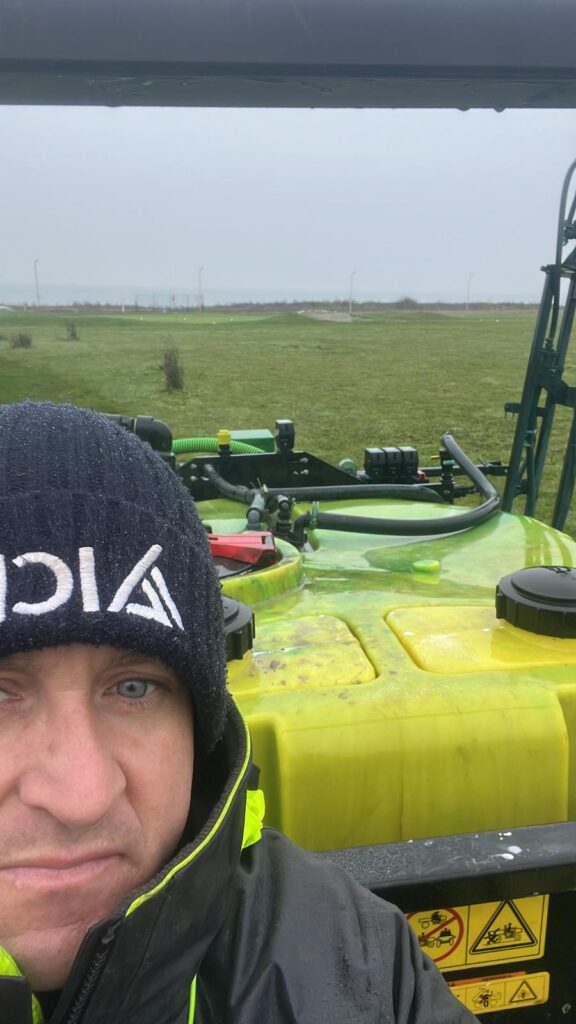
A: It was by accident, to a point. I’m a 1980s baby; I left school in 1998. I wanted to be a P.E. teacher because I’ve grown up with a cricket bat in my hand, a football at my feet — I wanted to do something involved in sports. Then, I messed up my A-Levels and needed something to do. I had a place at the University of Hertfordshire, and they told me that I’d have to defer a year while I redid some of my A-Levels. I ended up at my local golf club, Royal Cinque Ports in Kent, and I took on a six-month contract in October of 1998 with the thought that I would go to university in September of 1999. Well, we’re now in 2026, and I’m still in the turf industry. I did go back to University in 2008, but once I finished my degree, I went straight back to the golf course. I became a P.E. teacher without setting foot into a classroom.
Q: Looking back at that first role, what stuck with you until today? What starting point kept you in the industry?
A: Initially, it was cash in my pocket. I didn’t enjoy being a greenkeeper for the first year, but something twigged in year two that I quite liked working outdoors in the summer. I enjoyed working in a team of like-minded people; we were a group of lads having a laugh with each other. It suited my personality; it was almost like that cricket/football dressing room whilst being at work. I went travelling for a few years and very easily came back and found work. I would say really, I think it was being outside on a large site, and the variation across the jobs. Still to this day, I hate raking bunkers, but I quite like being outdoors. The days when I’m stuck in front of a laptop, maybe editing or filling out spreadsheets, I don’t find them overly enjoyable. I’d say it’s the outside element and the fact that the job varies day-to-day.
Q: In that stage of your career, what did you think greenkeeping was going to become? You mentioned the group lifestyle, but did you foresee it being as it is now? If not, what did you think it was going to be?
A: In 2001, when I’d saved up £5,000 to go to Australia, I thought I was going to get a job on a golf course over there. For various reasons, that didn’t happen. I had come from a messroom where everyone seemed to think I was the young, educated one. I wasn’t really — I just had my GCSEs. But because I had these, everyone told me, “If you hang around greenkeeping, you’ll become a head greenkeeper one day.” I didn’t believe them; I just didn’t think that was the career path. To answer your question, I thought it could possibly, if not take me around the world, take me away from my hometown. I could see some different places whilst mowing grass and managing golf courses.
Q: How did having the experience of moving overseas shape you, even if not work-related?
A: I realised soon enough that the world really isn’t as big as some people might think, and I went as far away as you can pretty much get from the UK. I was due to go with a friend, and he went off and joined the Navy. I could have decided that I wasn’t going to go, but I booked my flight. I had somewhere to live — I was going to stay with someone who had been playing cricket in the UK. I had some money in the bank; I think my dad actually gave me some money to stay away. I flew over to Brisbane, and one of my grandfathers passed away a couple of hours after I arrived. Had I needed to, I could have flown home, just 24 hours on the plane. There was internet; I had my online banking account. I could text home. Once I got there, I realised that although I was on my own, I wasn’t alone. That might sound like a cliché, but it’s true.
Q: What would you say to young people about when is the best time to work overseas?
A: Life has a habit of allowing you to do things when you’re younger, but you also have less access to financial resources. If you’re in the privileged position where you can borrow money from family members, do it when you’re young, but don’t let not being young stop you. My wife and I had our daughter when we were 36. So, once we had our first child, it would have been slightly restricted. It wouldn’t necessarily have stopped us. But if you’re 20 to 25 and you’re thinking about going abroad, book the flight. You can go and work. If you’ve got £500 in your pocket, you can make it work, because you can go and find something. If you don’t do it, you might look back and regret it.
Q: So, around the 2003-2005 area, you said you’d had enough of golf. Can you tell us more about your mindset at this time?
A: I enjoyed my first years in golf. I worked for a head greenkeeper who was more of a mechanic in the shed. He was a good boss. I enjoyed my three years there. When I came back from travelling, I worked at two clubs that I won’t name, and I didn’t enjoy it. I got out of golf and went to work at a private school in Dover. It was a wonderful two years managing sports pitches and formal gardens. I was starting work at 7:15 AM, which was great, I wasn’t working weekends, and I had a wonderful relationship with some of the staff members. It was a real pleasant place to work. The downside was that the salary was extremely low. I was 25 and decided that I needed to start making more money, and that was when I went to work at the world-famous Royal St George’s Golf Club (also in Kent).
Q: Do you think poor pay is still something that puts people off a career in this industry?
A: It’s a huge problem, and something that I’m passionate about. If people don’t start scaling this pay properly and openly and honestly, we’re going to continue to see school leaders joining the industry whilst living at home, and not be able to sustain a lifestyle on the salary as they get older. I think it needs to be scalable. If you come and put three or four years into this industry, I think you need to be earning £30k minimum. I don’t know the answers because, if I relate things back to golf, I do fully appreciate that there’s only so much that small golf courses can charge their customers. If we continue to talk about recruitment problems, then we hopefully won’t be talking about them in 20 years’ time.
Q: Coming back to your time at Royal St George’s, what was the draw for you to move back into greenkeeping?
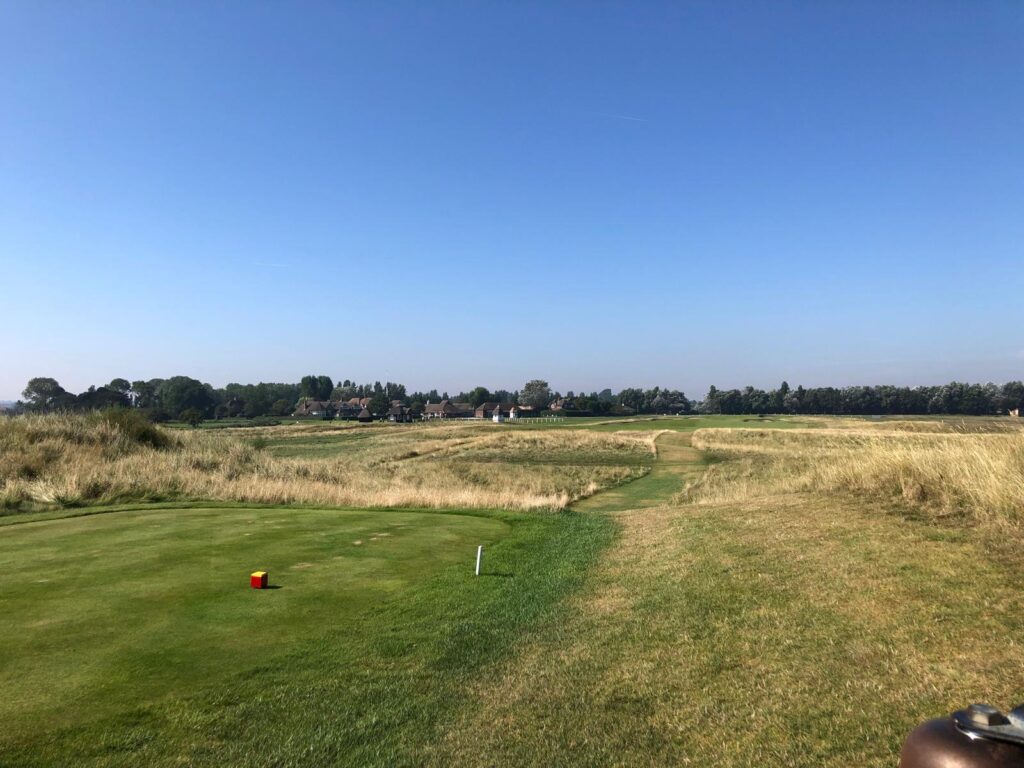
A: The pay was considerable, it was around an £8.5k pay rise. It was closer to home, and I had a good friend there. I still considered myself a greenkeeper. I applied for a job there and didn’t get it, but luckily for me, about six weeks later, another member of staff left. They offered me a role without an interview, and my career kicked off. Having Royal St George’s on your CV makes it quite easy to progress your career, which I did. After a couple of years, I took on my first deputy greenkeeping position, which turned out to be a complete and utter career killer for a while.
Q: How do you think your multisports experience helped when you returned to golf?
A: I just came back to golf a lot more rounded. I had a lot more exposure to doing everything. We were a three-man team at Dover College, so I had to do everything. I came back a bit more grown-up. I was used to having to get on with things and working out how to problem-solve, which you get a lot more exposure to in a small staff.
Q: So, what happened in your deputy greenkeeping role?
A: I joined a greenkeeping team with a large divide between the guy in charge and those working below, and I tried to be the middle ground. I played it wrong, and seven months after taking that role, I was no longer there. I wasn’t fired, but I was removed from my position prior to completing the probation period. Looking back, I can fully understand why. I wasn’t experienced enough. It’s in the past, and I’ve learned from it. I have used that experience for the positive in the future. Luckily for me, that position saw me land in the middle of a pine forest in the Czech Republic a few months later, and I had a brilliant year-and-a-bit out there.
Q: How did that experience teach you about leadership and management?
A: If you don’t carry on professionally in a professional setting, everything becomes amateur, and it did. I tried to give the lads an inch, and of course, they (the team) took a mile. I’m then chasing it, trying to manage up to the boss, and justify what I’ve done. The reality is, we were there to work and produce a golf course. I had this misguided thought process that I wanted it to be the most enjoyable experience for everyone. As much as you want to enjoy yourself, to a point, you’re there to work.
Q: What made you want to try working overseas?
A: When I came back from my time in Essex, I’d taken a job working for a local gardener. I found an advert, I think it said “Jobs across Europe, CVs welcome.” I sent off my CV and not long after had a phone call about a job available in the Czech Republic. I was then offered the job almost immediately and asked if I could leave next Wednesday. I had no commitments. It was, “What was the worst that could happen?” If you don’t like it, you can just fly home.
Q: Coming back to your teaching qualification, did that help to shape you as a manager? What could you carry from that into the greenkeeping world?
A: The biggest thing I took away is how much you have to understand that we’re all so different individually. It’s impossible to manage 30 individuals in a classroom, but it’s also impossible to do the job properly if you don’t try. You haven’t got time to tailor a lesson to 30 people, but you have to find a way to teach, train, coach, and manage people, so that they can get the best out of the time they spend with you. You can learn all the theory, but if you take the time to try to understand people, you will benefit from it.
Q: What are some of your standout moments from working at the Royal St George’s?
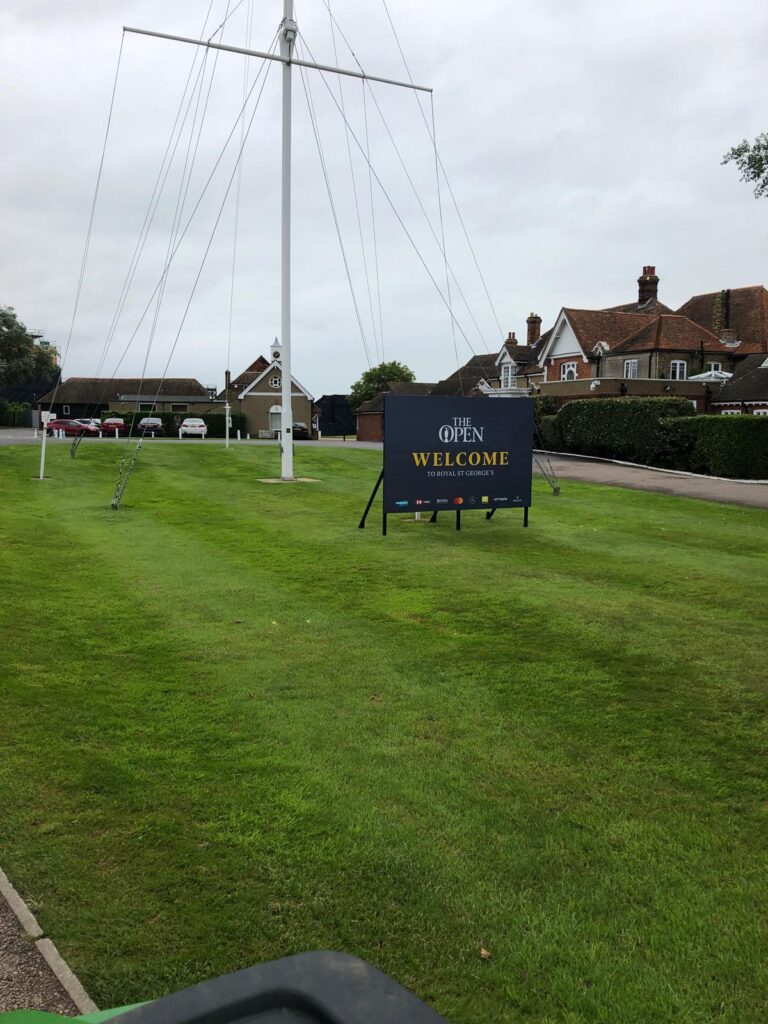
A: The two Opens that I did were fantastic experiences. The second one was a wonderful experience, but a tough experience at the same time for me. That first Open in 2011, it was great. I absolutely loved it and hated it at the same time. When I look back at it, it didn’t make me stronger or any better. But to have been lucky enough to have experienced that twice… being involved in something that produced what it produced in the end, you can look back with a certain element of pride. But you do live in the madness for those months in the buildup to it.
Q: For you, how did your head greenkeeping role in Kent differ from your roles in the past?
A: All of a sudden, I was the person everyone was asking questions to. I’m also getting emails for meetings, emails about budget, ordering… It all comes with the job, and I quickly realised that I couldn’t go out and cut the greens in the morning because, come 7 AM, my phone was going and my emails were coming in. Trying to manage people on an individual level was difficult. There were points where I had to say to people, “This is the way it has to be. I appreciate how you want to do it, how you think it should be done, but this is the way it’s going to be done. How you operate that greens mower, there’s a bit of leeway in there, but the end result has to be to my liking.” You don’t want to sound like a dictator, and I tried to be a good, understanding boss. But there comes a point where it’s like, “The end product has to be this, and we all have to get on board.” It’s a reflection on us as a team.
Q: Looking back, has your interpretation of success changed?
A: Yes. From my last role, I interpreted success as producing a good golf club for the members and having a happy team. I had a huge emphasis on a happy, professional team that had to produce a good golf course. When I first started out, success was very one-dimensional and was about my career. I’m now a husband and a dad, and success is now a whole life thing. Some of the things I’ve gone through in the last decade have allowed me to step back and realise that there is a bit more to life than perfect golf greens.
Q: Yes, I know you’ve been sober since 2017. Would you like to share that story?
A: I’d grown up enjoying a drink, drinking at weekends. I was a binge drinker. My daughter was born in 2016, and by the middle of 2016, I was finishing work three hours before my wife came home from her job and my daughter came home from nursery. I got to the point where I was drinking a bottle of vodka between finishing work and my wife coming home. I became reliant on alcohol to cope with situations that I wasn’t able to deal with. The honest way to say it is that life just got the better of me. I turned to what I have always relied on to take me away from reality. I went through 16 months of my life as a functioning alcoholic, where I would go to work, come home, and drink myself silly. It wasn’t sustainable and I ended up in hospital. I was told that if I wasn’t able to stop drinking, I wouldn’t be alive for much longer. I was mentally broken, but somehow I didn’t cause any damage physically.
Q: What advice would you give to someone in our industry who is struggling with a similar addiction?
A: If you’re struggling, the first thing I suggest is go and see your GP, because they are the first point of contact. If you’re really struggling to the point where you’re considering doing harm to yourself, there’s Samaritans, and there are phone lines. If you’re worried about your habits or what you’re putting into your body, and it’s having a detrimental effect on your ability to live and do your job, reach out to your GP. I’m easily available on Facebook and X, but I’m not a professional. I can share my experience with alcoholism, and I can tell you what worked for me, but ultimately, you’re going to be pointed in the direction of professionals. If you go with an open mind and if you really want to change, it does get better. It seems impossible, but it does. So far, I haven’t picked up a drink since 17th December, 2017.
As for the turf industry and other industries, they need to get to the point where individuals’ mental wellbeing is managed 12 points of the year throughout their career. It shouldn’t just be “mental health awareness week”. I think we could do better.
Q: Thank you for sharing your story. Moving on to our quick-fire series, what would you say is your favourite part about working in sports turf?
A: It would be the outside element for me.
Q: What would you say is the most challenging problem that you’ve ever faced, and how did you handle it?
A: Becoming a head greenkeeper and having to deal with 400 people who knew my job better than me. When you fall out with a golf club member and then take the tractor with a load of turf to block in where he parks on your site, that’s not the right reaction.
Q: What would you say is your way of unwinding after a hard day at work?
A: It’s always running, now. In this profession, I think it allows us time to do what we like. So, I will come home from work and I’ll run between the time that work finishes and my daughter comes home from school. It’s a tool that I’ve used since COVID to de-stress.
Q: If you could switch roles with anyone in the grounds or greenkeeping industry for a day, whose job would you want to try and why?
A: I’d be the head greenkeeper at St George’s for a day, because I’ve been told by multiple head greenkeepers down there how it is when you do into the big rooms, so I’d just like to see if they’re telling me the truth.
Q: What’s one piece of greenkeeping equipment you couldn’t live without?
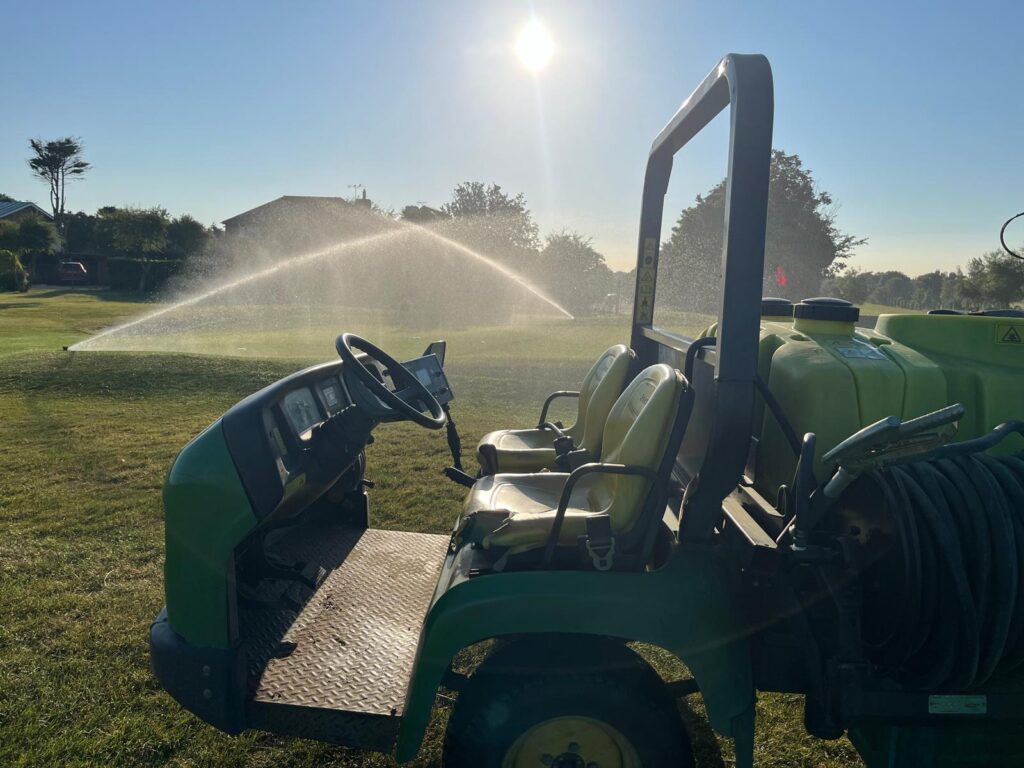
A: The best piece of greenkeeping equipment to hit the market in the last 20 years is the (Toro) ProCore. We need the sprayer, but what the ProCore has allowed turf professionals to do with limited disruption to playing surfaces is… You can get out with the ProCore, you can aerate nine greens ahead of play, and after two days, you’re done. If you’re needle-tining, people don’t even know you’ve been there.
Q: Going right back to the start, what advice would you give to someone looking to get into our industry?
A: Value yourself, but what you might find, and this is counterintuitive, is that there’s no value in the turf industry. If you’re coming to the industry in a position where you can live off what it pays, then get into it, because it’s very enjoyable. You may have to experience a few different workplaces before you can find the one that fits you. It is a good industry. It’s an industry that will be around, because golf isn’t going anywhere. I hope that it’s going to start valuing itself better, but I fear for it. My advice would be don’t be scared to move on. Don’t expect huge financial moves in this industry in the next decade, but let’s be hopeful that things progress.
Thanks very much to Stuart for taking the time to chat with us today. You can find him on Facebook and X, or email him at stuartbutler79@hotmail.com.
If you’re struggling with addiction, Mind UK has some fantastic resources and links to contacts where you can get help. You can also call Samaritans for free at any time on 116 123.