
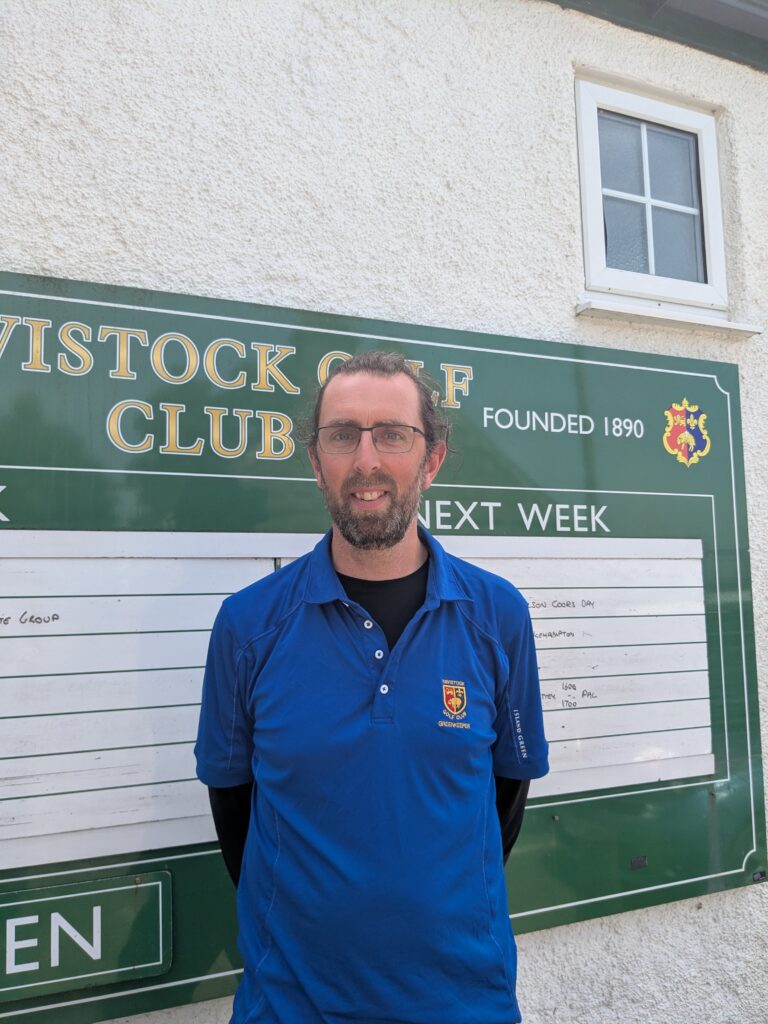
In this interview, we’re joined by Garry Letheren from Tavistock Golf Club. Garry has built his career in greenkeeping through a genuine passion for the profession and a real commitment to continuous learning. He’s an active participant in BIGGA’s Continuing Professional Development programme, always looking to improve his knowledge and develop new skills. Outside of work, Garry is also a keen runner with Tavistock Athletic Club, and we’ll be chatting about how that discipline, resilience and determination carry over into both his professional and personal life.
We’ll be talking about Garry’s journey into greenkeeping, what life is like at Tavistock Golf Club, why professional development is so important in our industry, and how learning from other sectors can help us all become better turf professionals. We’ll also discuss the future of greenkeeping, attracting the next generation into the industry, and the importance of staying motivated throughout your career.
Q: Take us back to when you joined the industry. How did you decide to become a greenkeeper?
A: I grew up on a farm, so working outside is where I feel the most comfortable. I started out as a mechanic, but my first job in greenkeeping was at The Ashbury Resort (Devon, UK). I had family working there, and I wanted to work outside again. For me, golf wasn’t in my peripheral, and not working in a farm was a bit of a random thing to do. But working outside was something I’d done in a different context. So, starting in Ashbury was like working with home, but without the animals!
I spent the first couple of years just doing small tasks, but I was there for 11 years. Greenkeeping was something that I grew to love over the years. Once I’d left to do other things, when I came back, I realised this is actually what I want to do. Now, I’m trying to make this a career, whereas before, it was just a job I enjoyed.
Q: Has golf been a part of your life prior to working at a golf course?
A: Not really. I’m a runner, and I play darts. Golf is something I’ve attempted, and I know it’ll probably help, but being 6’5, it’s hard to find second-hand golf clubs to play properly. At Ashbury, we were doing 50-hour weeks. I loved the job, but I didn’t want to go back to play at the end of the day. It’s something I always thought I’d like to play, but for me, it just hasn’t gelled.
Q: Who has been the biggest influence so far in your career?
A: For my work ethic and my efficiency, my two old managers from Ashbury, Pete Gross and Steve Harris. They were quite firm on how things had to be done: quickly, but the right way. Every green had to be cut every day, tees and fairways had to be cut twice a week. It’s the sort of place where you either left before you’d done a month, or if you were there for a month, you were there for a long time. My work ethic has all been from that experience. You might not have liked it when you started out, but when you move to another role with another company, the job feels easy.
Q: What has been the biggest lesson in your greenkeeping career so far?
A: I’d say a lot of things from Ashbury, because I was there for 11 years. Because it was so big, every time you went out, and you’d rake a bunker, and the next time it’d rain and you’d rake the bunker again. I asked myself, why am I doing this? One week, there was a monsoon all week, and we didn’t rake bunkers for a week.
After that, it took our team of five weeks to wheelbarrow the sand all back up. I then understood that those small tasks that seem pointless are actually worth it to save you a lot of time in the future. Don’t look at the job as a whole. Look at where you are, and just keep moving forwards. Do the mundane. It might not be exciting, but sometimes the mundane jobs make the right people.
Q: Have you been defined by any mistakes you’ve made, or any issues you’ve faced?
A: I’ve had a few things happen, wheels falling off, things breaking on me, and so on. I’ve obviously made mistakes over the years, but I can’t think of any. I think with the way my brain works, when I see someone else’s mistake, or if I’ve made a small mistake, I ask what could go right or wrong. Nine times out of 10, I’ll pre-empt a mistake. So, if I’m asked to go and it does happen, I don’t see it as a mistake.
When I started here (Tavistock Golf Course, where he currently works), we call surrounds what I used to call collars. I’d been here six months, and as you go into winter, the definition disappears a bit. We cut around the edge of the fairways with a mower to make sure you can see it. I was asked to cut around the outside of every fairway, so I did that. Three fairways in, they asked me what I was doing, and it turned out, they meant the cleanup lap inside the fairway. It was my mistake, but I think it was a communication error. I realised I needed to ask for clarification rather than just doing as I was told.
Q: Tell us about Tavistock Golf Course.
A: The club was founded in 1890, and it was first opened in 1891. It’s now being leased by the council. There’s also common land, and a cricket club. It’s open to the public within reason; greens are obviously fenced off. Surrounded by moorlands, it’s great for drainage. In the winter, there are areas that can get very wet, so we take actions to protect the moorlands and the golfers. When people come here, it’s for the views, and for the animals.
Q: What are the biggest challenges that come with maintaining the course?
A: There’s quite a lot of granite and stones in the ground. While this helps us when it’s wet, we struggle with definition with a few of the fairways. It can also be tricky to work around the public and the animals. Everything we do, we have to make sure that the public won’t be in danger and the animals won’t be spooked and run across the roads. We maintain the greens to a high standard, and with the tees, we try our best. Because of the ground, every job takes that little bit extra. Also, there’s no irrigation whatsoever. We drive a tractor to every green to spray them with water, which is a daily job in the summer.
Q: What’s your favourite time of year here on the golf course?
A: Definitely the summer. It’s such a beautiful place. In the summer, we have the young foals out, the ponies, the golf courses. Here, it’s just different from other golf courses. It’s being in nature. There’s the manicured green, but you’ve got a sheep next to you. Everything is done to a high standard, but it’s not a manufactured finish. That would look out of place here.
Q: If one of the golfers here had to spend a day with you, what do you think they’d say was the most difficult part of the job?
A: I’m not sure if they understand what we go for in the morning. You’re cutting tees, you’re clearing up after the animals. They see the others doing their work, but I think sometimes they’ll comment that the bunkers aren’t looking right. We’ve got over 50, and I don’t think they realise that the amount of effort we put in every morning to make sure everything is maintained. We start at 6 AM, or 5 AM on a weekend. Here, the members are so accommodating. They see us every day, and they know we’re not trying to annoy them on purpose.
Q: You’ve said that you want to continue to develop and learn within the industry. Why do you think it’s so important to continue to educate yourself?
A: When I started, I just did what was asked of me. But when I met my wife, she works for a university, and she’s got two degrees and has a lot of learning. It made me realise that if I want to progress in my career, I need to put in the learning. From where I was when I started greenkeeping in 2005 to now, things have changed so much. Yes, you can keep on doing the same things you’ve been doing for 20, 30 years, but you can learn new techniques to speed the job up or do better for the environment. Education is a lot more accessible than it was when I was younger.
Q: How do you think the sector has changed over the past decade or so?
A: We’re still very analogue over here, but reading the BIGGA magazines and learning about the robot mowers, it’s definitely helping with taking some man-hours away. You’ve then got those man-hours to do more maintenance on the green. Machines won’t take over; they’ll give us more time to do other things.
Q: One of your favourite hobbies is running. Can you tell us about that?
A: When I left college, I said I wanted to run the London Marathon. In 2018, I decided to enter the London Marathon ballot, but I hadn’t run since I was 22. So, I joined the local running club. I didn’t get that ballot, but I ran in London in 2021. In 2022, I ran Manchester, which was my fastest run: 3:46. Then, this year just gone, I did the Dartmoor Marathon, and I’ve got Loch Ness in September. In the winter, all your work dies down, and if your fitness stops, you notice it. In the winter, I try to run every other day, in all weather.
Running gets your head clear. You can’t think about life because you’ve just got to think about surviving. The mindset definitely helps with work. If I say I’m going to do something, I’ll do it. I’ve had one day off sick in the two years that I’ve been here.
Q: Coming back to greenkeeping, is there anything you think we need to be doing to attract more people into the industry?
A: Just being approachable. Maybe we have to look at how things are structured. People are different nowadays. Yes, there are people like me who will get up at 5 AM on a Saturday and work the hours, but you want to make them enjoy it and fall in love with it first. It’s also worth introducing people with a tour of the grounds, rather than just assigning them a job and sending them off to shadow someone.
Q: What do you think matters more, apprenticeships or qualifications?
A: I think both routes are fine. I did an apprenticeship, which involved hands-on work at a golf course. From the course perspective, having someone come in and learn your practices is invaluable. You can show them how you do it and mould them, rather than them being quite rigid.
Q: What do you think is one skill that every modern groundsman or greenkeeper needs to have outside of turf knowledge?
A: Mechanical knowledge, so they can get equipment up and running again if it goes down. Most clubs can’t get mechanics in to fix machinery as needed, so being able to fix it yourself is incredibly helpful.
Q: What would you say is the most underrated job in a golf course?
A: I think it’s generally the maintenance of the furniture. You’ve got the bins, the benches… they’re there all the time. If you don’t do them, they’re a focal point, but if you do do them, they’re never mentioned.
Q: Do you think a tight budget or high expectations is tougher?
A: I think a tight budget. No matter what budget you have, people are always going to have high expectations. You’re always going to the best you can, but it’s the budget that restricts you. Budget allows for that last little flourish.
Q: Is there any one thing you want to achieve in your career?
A: I’d like to become a deputy head greenkeeper. I’d also love to move to Scotland. If the right thing comes up one day, that’s my retirement project. Scotland is definitely ahead of time, but I’d like to work my way up rather than walk into a job.
Q: If you could switch roles with any greenkeeper or groundsperson for the day, what job would you choose and why?
A: It’s a hard one, because do I want to do something completely different, like football or cricket? Or do I want to end up somewhere where I can see a sport that I’m into? I love motorsports, so it sounds very boring, but I’d probably like to go to Silverstone and work on their grounds. It’d be great to get to work on another amazing golf course, or Old Trafford, or the Etihad. But if I’d spend the day, I’d try to wrangle it in my favour, where I could do and watch the sport. It’d probably be Silverstone on race day.
Q: How would you unwind and relax after a difficult day at work?
A: I’ve got a cocker spaniel called Ralph, so I’d walk him for an hour. I usually go home and then walk him back around at work again. It’s nice, as it’s not like places I’ve worked before, where I don’t want to return. I run most evenings, too.
Q: Finally, what’s the one piece of greenkeeping equipment that you couldn’t live without, and how does it make your job easier?
A: I like the (Toro) ProCore. It’s so versatile, especially with a small place like this. It’s such a light piece of equipment rather than running a tractor over everything. There’s so much more innovation and more equipment coming through, but for me, especially in a small course, the ProCore is definitely my favourite piece of kit.
Q: Finally, if you could change one thing about the sports turf industry as a whole, what would it be?
A: I would like to change people’s perspectives of the industry. The whole industry is amazing. Social media is helping, and we need to start doing more. That might mean obtaining media training.
Our thanks to Garry for taking the time to chat with us for this Meet the Members episode. You can find him on LinkedIn here.