
Sponsored article: Kersten UK
With the UK Pesticides National Action Plan (NAP) 2025 now firmly in force, the conversation around municipal weed management has undergone a radical shift. We are no longer just talking about horticulture or aesthetics; we are talking about civil engineering, legal compliance, and structural asset protection.
With the UK Pesticides National Action Plan (NAP) 2025 now firmly in force, the conversation around municipal weed management has undergone a radical shift. We are no longer just talking about horticulture or aesthetics; we are talking about civil engineering, legal compliance, and structural asset protection.
To tackle this head-on and establish a statistically significant evidence base for large-scale best practice in Integrated Weed Management, a major industry collaboration has been formed. Kersten UK has joined forces with Complete Weed Control, the UK’s leading specialist contractor for precision weed management, and the forward-thinking Bracknell Town Council. Together, they have launched a landmark Integrated Weed Management field trial in early 2026 to prove that proactive mechanical hygiene is the foundation of any successful Integrated Weed Management Strategy.
The Science of Pavement Ecological Succession Data from the trial proves that we have been looking at street weeds incorrectly. Most trials treat all weeds as equal, but success actually depends on two variables: Soil Depth and Silt Maturity.
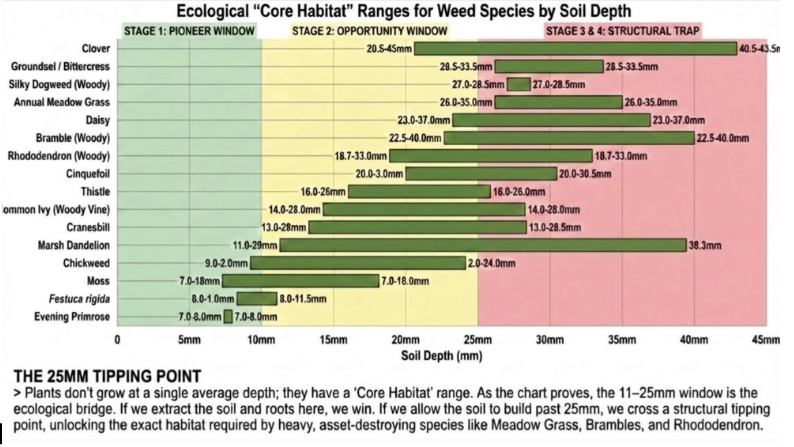
Weeds do not appear randomly; they follow a predictable ecological timeline based on the depth of the soil that has accumulated in gutters and on hard surfaces. This process, known as “Pavement Ecological Succession,” categorises street degradation into four distinct stages:
- Stage 1: The Pioneer Window (<10mm soil): Pioneer species like moss and evening primrose appear. While they don’t immediately damage the tarmac, they trap the detritus needed for the next stage.
- Stage 2: The Opportunity Window (11–25mm soil – Recent): This is the critical intervention zone. Herbaceous weeds like cranesbill and thistle take hold. Crucially, because the silt accumulation is recent, their roots are effectively “floating” in the surface dirt rather than penetrating the asphalt.
- Stage 3: The Trap (11–25mm soil – Aged): This is where the battle is lost. If the Stage 2 silt is left for a second growing season, the root system seeks moisture and drives its taproot through microscopic cracks in the asphalt. The root is now firmly “anchored”.
- Stage 4: Structural Failure (>25mm soil): Once soil builds past the 25mm tipping point, it unlocks the exact habitat required for heavy, asset-destroying perennials like annual meadow grass and woody brambles.
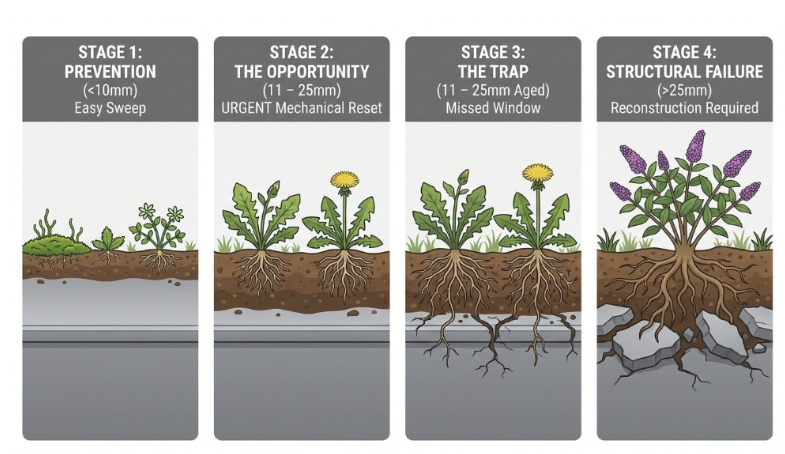
Roots don’t usually create potholes directly; they degrade the surface at the edge of the road. Once the integrity of that edge is lost, cracks appear in the middle of the tarmac. The winter freeze-thaw cycle then forces these cracks open, resulting in expensive potholes.
The 15-Minute Diagnostic Protocol: The Kick Test How do greenkeepers and highway inspectors know if a street is saveable (Stage 2) or failing (Stage 3)?
The answer is the “Kick Test”. Walk up to a weed in the gutter and kick it.
- Floating: If it moves with the dirt, it is in recent soil accumulation. A heavy mechanical brush can cleanly lift the silt, the weed, and the entire root crown off the pavement, achieving 100% extraction.
Anchored: If it is stuck firmly, it has anchored into the infrastructure. A brush will only snap the top off the weed, leaving the root safely underground to regrow.
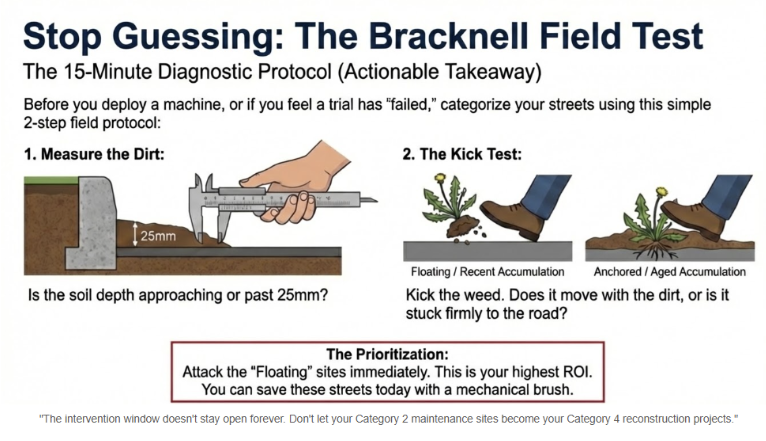
If you trial a mechanical brush on a Stage 3 street, it will look like a failure because you missed the chronological window to intercept the root before it became part of the road.
Putting Theory into Practice: The Bracknell Field Trial The collaborative trial evaluates a structured ‘Proactive Asset Management’ system to navigate these exact stages. By combining Kersten UK’s specialised mechanical surface preparation with the WEED-it precision application technology operated by Complete Weed Control, the partners aim to quantify the massive reduction in chemical input achieved simply by removing the detritus.
“This collaboration represents a shift toward evidence-based surface care,” explains Sean Faulkner, Director at Kersten UK. “By working alongside the experts at Complete Weed Control and the forward-thinking team at Bracknell Town Council, we are proving that mechanical hygiene is the foundation of any successful herbicide reduction strategy. We aren’t just managing weeds; we are protecting the longevity of the infrastructure itself.”
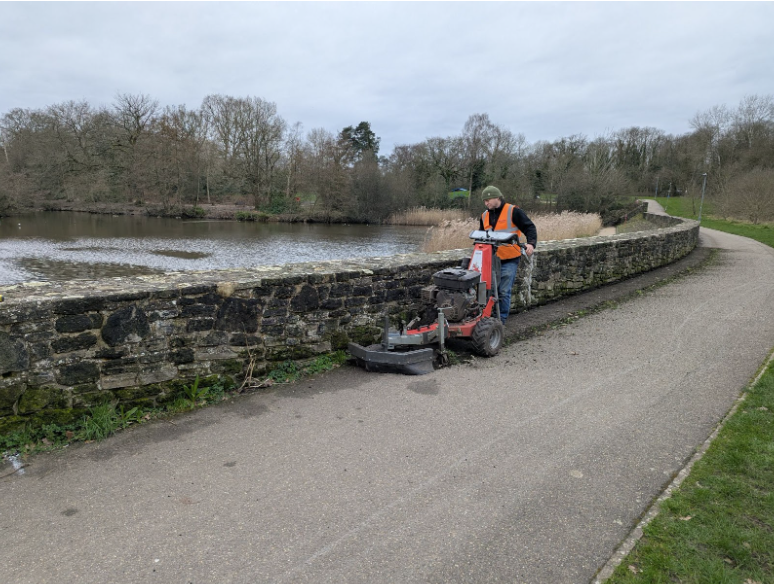
Bracknell Town Council is serving as the primary research partner, providing access to diverse public areas, including Birch Hill Play Area, Mill Park Recreation Area, Winscome Play Area, and The Elms Park. These sites offer a variety of surface challenges, from encroached footpaths to sensitive pond-side kerb lines. Complete Weed Control will provide certified operators to precisely measure herbicide volumes, whilst Kersten UK will utilise specialised equipment to reclaim and maintain these surfaces to a ‘bare asset’ standard in accordance with COPLAR Guidelines.
The Financial Bottom Line For grounds care professionals and local authorities, ignoring the time factor and the 25mm soil depth threshold is a costly mistake. Preventative surface treatments (Categories 1 and 2) typically cost less than £10 per square metre, whereas resurfacing after structural root failure (Categories 3 and 4) often exceeds £100 per square metre. Furthermore, sweeping detritus out of gutters mechanically prevents it from washing down drains, saving a fortune on reactive gully emptying.
The intervention window doesn’t stay open forever. Full results from the season-long Bracknell study are expected in early 2027, but the mandate for greenkeepers under the live NAP 2025 is already clear: attack the “floating” sites immediately, rely on evidence-based partnerships, and stop treating maintenance issues as capital reconstruction projects.